Planning your FUE procedure? One of the most common questions we hear at FUEsion Hair Clinics is, “What should I expect after surgery?” This guide lays out a detailed FUE hair transplant recovery timeline—from day 1 through month 12—so you know what’s typical, what’s not, and when to reach out.
While every patient heals at their own pace, understanding the phases of graft recovery can reduce anxiety and help you follow your aftercare plan confidently. Use this as a roadmap, then confirm your specific instructions with your surgical team.
Quick note: timelines can shift based on graft count, scalp sensitivity, hair caliber, medication use, and whether you undergo adjunct treatments (like PRP, low-level laser therapy, or targeted anti-inflammatory regimens).
Understanding the FUE hair transplant recovery timeline
In an FUE (Follicular Unit Extraction) hair transplant, individual follicular units are harvested—typically from the donor area (often the back and sides of the scalp)—and then placed into recipient sites. Your “recovery” is really a sequence of biological events: wound healing, graft stabilization, shedding, and then regrowth.
Most patients experience predictable milestones. The key is knowing which symptoms are normal and which may signal an issue such as infection, excessive inflammation, or delayed wound healing.
Day 1 through Day 14: the early healing phase
These first two weeks focus on protecting grafts, keeping the recipient area clean, and allowing the tiny extraction/implant wounds to stabilize. Swelling and tightness are common, and the scalp may feel sensitive.
Day 1 (surgery day)
- What you may notice: bandaging or dressing, mild bleeding/oozing at recipient sites, numbness or tingling, tightness.
- Typical sensations: soreness similar to a mild sunburn; fatigue.
- What to do: follow your clinic’s dressing and washing instructions exactly; take prescribed medications (pain control, antibiotics/anti-inflammatories if given) as directed.
Days 2–3
- What you may notice: swelling may increase slightly; scabs or pinpoint crusting begins forming around grafts.
- Typical sensations: itchiness begins as healing progresses; tenderness may persist.
- What to do: avoid scratching; keep sleep position instructions (often slightly elevated) if provided; use only approved shampoos/cleansers.
Days 4–5
- What you may notice: scabs become more defined; redness may remain.
- Typical sensations: “dry” feeling; mild itching.
- What to do: gentle cleansing routine (as instructed). Avoid direct water pressure on recipient sites.
Days 6–7
- What you may notice: scab shedding begins in small areas; swelling usually starts improving.
- Typical sensations: scalp may feel less sore but still sensitive.
- What to do: continue gentle care; do not pick scabs. If you’re given a follow-up schedule, attend it.
Days 8–9
- What you may notice: progressive scab loosening; recipient area may look patchy due to crust removal.
- Typical sensations: itching can peak; dryness is common.
- What to do: keep moisturization/serums limited to what your team recommends. Avoid unapproved oils or harsh products.
Days 10–11
- What you may notice: most visible scabs begin to lift; redness continues to fade.
- Typical sensations: improved comfort; mild residual tightness.
- What to do: continue the instructed washing protocol. Avoid heavy exercise and sweating if advised.
Days 12–14
- What you may notice: recipient sites often appear more “healed,” though tiny extraction points may still be visible.
- Typical sensations: scalp sensitivity decreases; itching should lessen.
- Milestone: many patients feel more confident in social settings, though results are not yet visible.
Weeks 3 through 6: shedding (often surprising) and early signs of regrowth
One of the most emotional parts of the FUE hair transplant recovery timeline is the shedding phase. Shedding does not mean the grafts failed—it often means the hair shafts have entered a reset cycle while the follicles remain in place.
Week 3
- What you may notice: increased shedding of transplanted hairs; recipient area may still look slightly red or dry.
- Typical sensations: usually minimal pain; itchiness may persist mildly.
- What to do: keep your routine consistent; avoid aggressive scalp scrubbing.
Week 4
- What you may notice: shedding becomes more noticeable; hairs may fall out in clumps or individually.
- What to do: resist the urge to “check” grafts by rubbing. Let the process happen.
Week 5
- What you may notice: shedding often continues; some patients notice very fine regrowth or “stubble” in parts of the recipient area.
- What to do: follow the same gentle hair care plan; maintain nutrition and hydration.
Week 6
- What you may notice: shedding typically begins tapering, and follicle activity becomes more apparent.
- Milestone: you may start to see tiny new hairs (often thinner at first).
Weeks 7 through 12: new hair growth begins to take shape
This stage is where many patients first feel truly hopeful. The scalp may look less “empty,” and hairs may become more visible as they lengthen.
Week 7
- What you may notice: new growth may start as fine, soft hairs.
- Typical sensations: scalp usually feels normal.
Week 8
- What you may notice: increased density in some zones; hairs become slightly thicker.
- What to do: keep photos consistent (lighting, angle, distance).
Week 9
- What you may notice: gradual improvement in coverage; growth may still be uneven.
- Reality check: hair maturation is not linear—some areas grow earlier than others.
Week 10
- What you may notice: hairs can look darker and more defined.
Week 11
- What you may notice: continued lengthening and thickening; the “texture” begins to resemble your natural hair pattern more closely.
Week 12
- Milestone: many patients see meaningful visible progress, though final density and thickness are still months away.
- Common question: “Is this the final look?” Typically, no—this is a strong early growth phase.
Months 4 through 12: density increases, hairs mature, and results stabilize
The FUE hair transplant recovery timeline extends well beyond the first three months. Hair follicles cycle at their own pace; thickness and cosmetic blending often continue improving through month 12 (and sometimes beyond).
Month 4 (13–16 weeks)
- What you may notice: noticeable growth in length; improved coverage.
- What to do: continue your maintenance plan. If you’re using medications or adjunct therapies, consistency matters.
Month 5 (17–20 weeks)
- What you may notice: hairs thicken gradually; density improves, especially in areas with strong baseline follicle health.
Month 6 (21–24 weeks)
- What you may notice: more stable appearance; the “shape” of the hairline or treated zone becomes clearer.
- Common milestone: many patients can style more normally.
Month 7
- What you may notice: continued maturation; individual hairs may feel more similar to native hair.
Month 8
- What you may notice: density increases further; blending improves.
Month 9
- What you may notice: gradual thickening; less “see-through” appearance.
Month 10
- What you may notice: continued improvement; many patients are close to their best early result.
Month 11
- What you may notice: incremental gains; hair may look more uniform in texture.
Month 12
- Milestone: results commonly become clearer and more stable by one year, though subtle maturation can continue after month 12.
- Next step: your clinic may discuss whether additional density work, refinement, or maintenance is appropriate.
Common side effects after FUE—and when to contact FUEsion Hair Clinics
Most post-FUE experiences are mild and temporary. Still, it’s important to know what’s typical versus what warrants medical attention.
Common, usually normal side effects
- Swelling of the forehead/eyelids (often peaks within the first 48–72 hours).
- Redness at recipient sites (typically fades over days to weeks).
- Scabbing/crusting around grafts (expected during early healing).
- Itching as the scalp heals.
- Numbness/tenderness in donor and recipient areas (improves over time).
- Shock shedding or shedding of transplanted hairs (often weeks 3–6).
- Dryness or tight scalp sensation.
When you should contact the clinic promptly
Please reach out if you experience any of the following:
- Fever or chills.
- Increasing pain that worsens instead of improving.
- Excessive bleeding that does not settle.
- Signs of infection: worsening redness, warmth, swelling, pus, or a foul odor.
- Severe or spreading rash or hives (possible reaction to medications or topical products).
- Unusual swelling that significantly increases after the early days.
- Persistent numbness or new neurologic symptoms.
If you’re unsure, it’s always better to ask. At FUEsion Hair Clinics, we prefer patients reach out early rather than wait through a concerning symptom.
Aftercare essentials that support the FUE healing process
Your aftercare plan is one of the biggest controllable factors affecting comfort and graft stabilization. While protocols vary by patient, the principles below are widely used in medical hair restoration.
1) Follow your clinic’s washing and product instructions
Recipient sites are delicate during the first days. Use only the recommended shampoo/cleanser and apply it gently. Avoid strong rubbing, hot water, and direct spray pressure.
2) Protect the grafts from friction
Avoid activities that increase sweating or friction on the scalp early on. Sleep with recommended positioning and avoid tight hats or pressure.
3) Be realistic about exercise and heat exposure
Most teams advise avoiding heavy exercise, saunas, and direct heat during the early healing period. Heat can aggravate inflammation and increase discomfort.
4) Don’t pick scabs
Scab picking can disrupt grafts and prolong healing. If scabs loosen naturally, they can be managed with gentle washing as instructed—never by force.
5) Track progress with consistent photos
Because regrowth can be uneven, progress photos help you and your team evaluate true changes over time. Use the same lighting and angles each month.
How adjunct treatments may complement FUE recovery
Not every patient needs adjunct therapies, but many benefit from targeted support—especially if they have ongoing androgenetic alopecia, inflammation, or slower regrowth patterns. Your doctor should determine whether these options are appropriate for you.
Medication-based maintenance (doctor-directed)
Many patients are candidates for FDA-approved hair loss medications and/or clinician-prescribed regimens to stabilize native hair and support transplanted follicles. Your surgical team may recommend continuing or initiating therapies based on your history and risk profile.
Low-level laser therapy (LLLT)
Some patients use low-level laser therapy devices as an adjunct to support scalp and follicle health. LLLT is typically used consistently over months; it’s not a substitute for surgical restoration, but it may help optimize the environment for regrowth.
PRP and growth-factor support
PRP (platelet-rich plasma) is sometimes used to support scalp health. In select cases, it may be incorporated into a longer-term plan alongside FUE. Your clinic can discuss expected benefits and realistic outcomes.
Genetically guided hair health planning (optional)
At FUEsion Hair Clinics, we emphasize individualized care. Some patients explore personalized hair health strategies—including nutrition and scalp-support protocols—to complement surgical recovery. For example, tailored nutraceutical and scalp-support approaches may be used to address inflammation, nutritional status, and hair cycle support (always under appropriate medical guidance).
Important: adjunct treatments should be introduced only when your surgical team confirms it’s safe for your stage of healing.
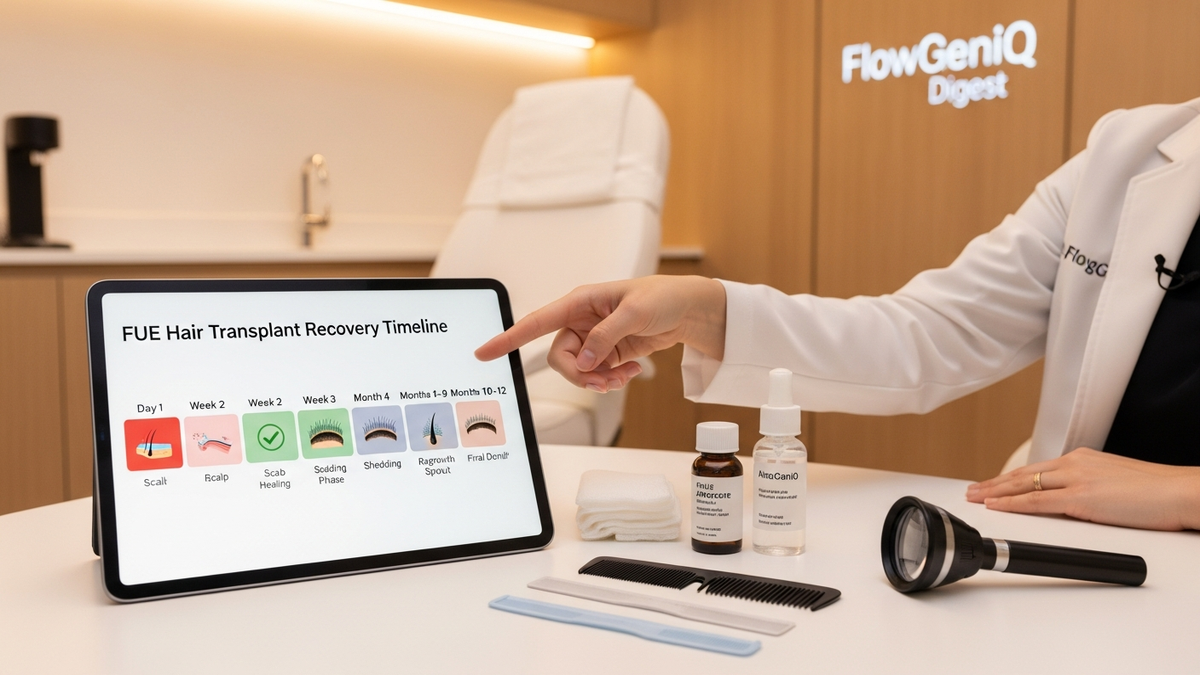
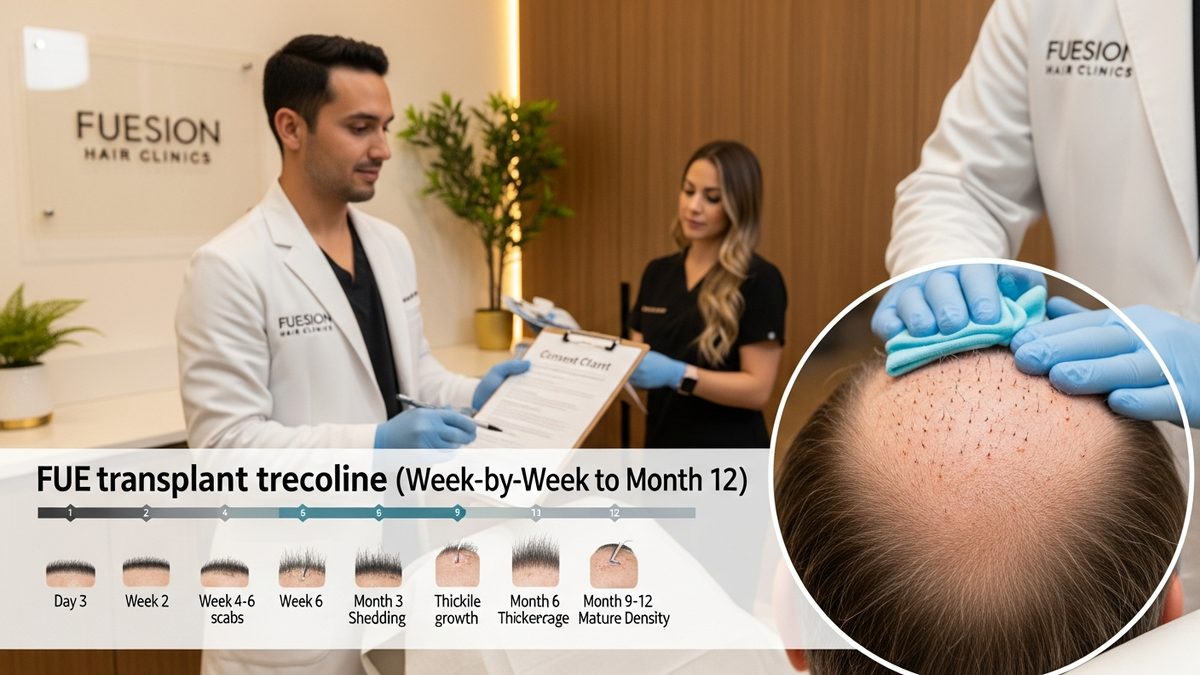
FUE hair transplant recovery timeline at-a-glance
If you prefer a quick summary, here’s the “big picture” view of the FUE hair transplant recovery timeline:
- Days 1–14: healing, swelling/redness, scabs/crusting, early comfort improvements.
- Weeks 3–6: shedding phase (often weeks 3–4), with early fine regrowth possible by week 5–6.
- Weeks 7–12: new growth becomes more visible; hairs lengthen and thicken gradually.
- Months 4–6: noticeable density improvements and better cosmetic coverage.
- Months 7–12: maturation, blending, and stabilization of final-looking results.
FAQ: FUE hair transplant recovery timeline
1) When will I stop shedding after my FUE procedure?
Shedding commonly occurs around weeks 3–6. It often tapers by week 6, though some patients notice ongoing shedding for a short period. New growth typically becomes more apparent after shedding begins to reduce.
2) Is scabbing normal after FUE?
Yes. Scabbing/crusting around grafts is a normal part of healing during the first 1–2 weeks. Avoid picking scabs; follow your clinic’s washing instructions to support natural loosening and safe healing.
3) When will I see real results?
Many patients notice early visible changes around months 3–4. More meaningful density and blending often occur between months 6–12, as hairs thicken and mature.
4) What symptoms mean I should contact my clinic?
Contact your clinic promptly if you experience fever, worsening or severe pain, increasing redness/warmth, pus or foul odor (possible infection), or a rapidly worsening rash/swelling.
5) Can I use supplements or hair-growth products during recovery?
Some patients use supportive nutrition or clinician-recommended scalp care, but timing and product selection should be individualized. Always confirm with your surgeon before starting new supplements or topicals during early healing.
Ready for your personalized FUE recovery plan?
Every scalp heals differently, and your best recovery experience starts with a surgical plan tailored to your donor quality, hair loss pattern, and lifestyle. If you’re considering an FUE hair transplant—or you have surgery scheduled—our team at FUEsion Hair Clinics can help you understand what your timeline may look like and how to optimize regrowth.
Schedule a consultation to review your candidacy, discuss expected milestones, and align on aftercare and any adjunct options that may support your results.
Medical Information Disclaimer
This content is provided for general educational purposes only and reflects the clinical experience and protocols followed at FUEsion Hair Clinics. It is not a substitute for professional medical advice, diagnosis, or treatment. Patients are advised to consult a qualified hair restoration specialist for personalized recommendations.