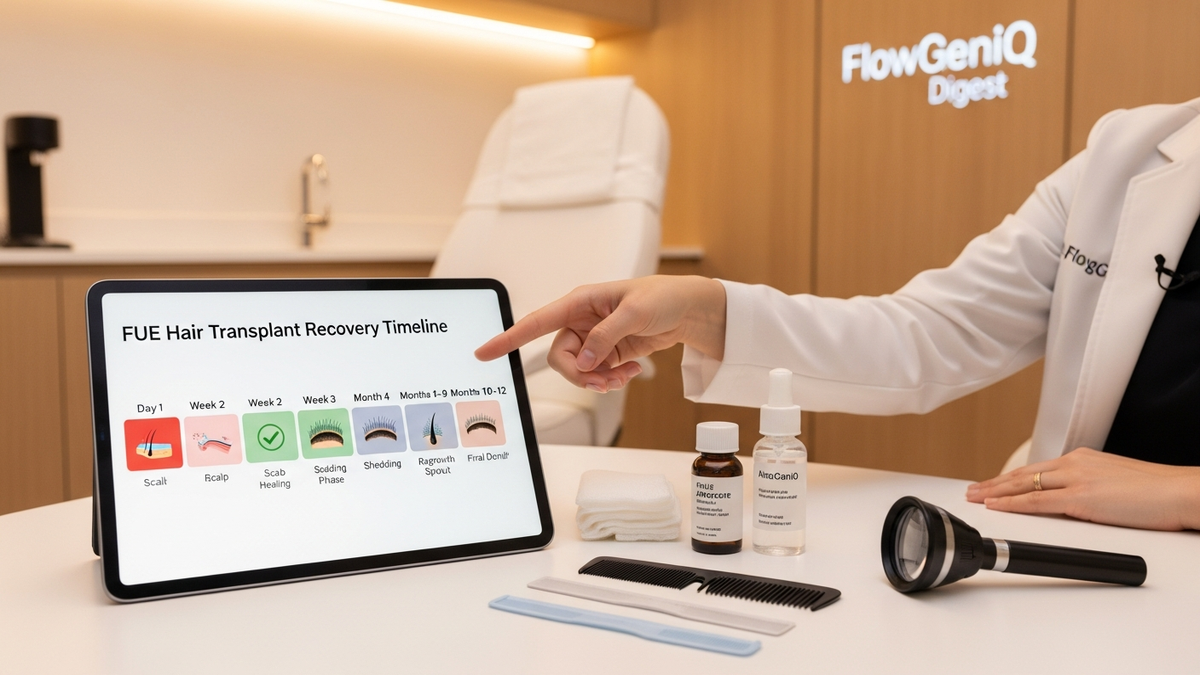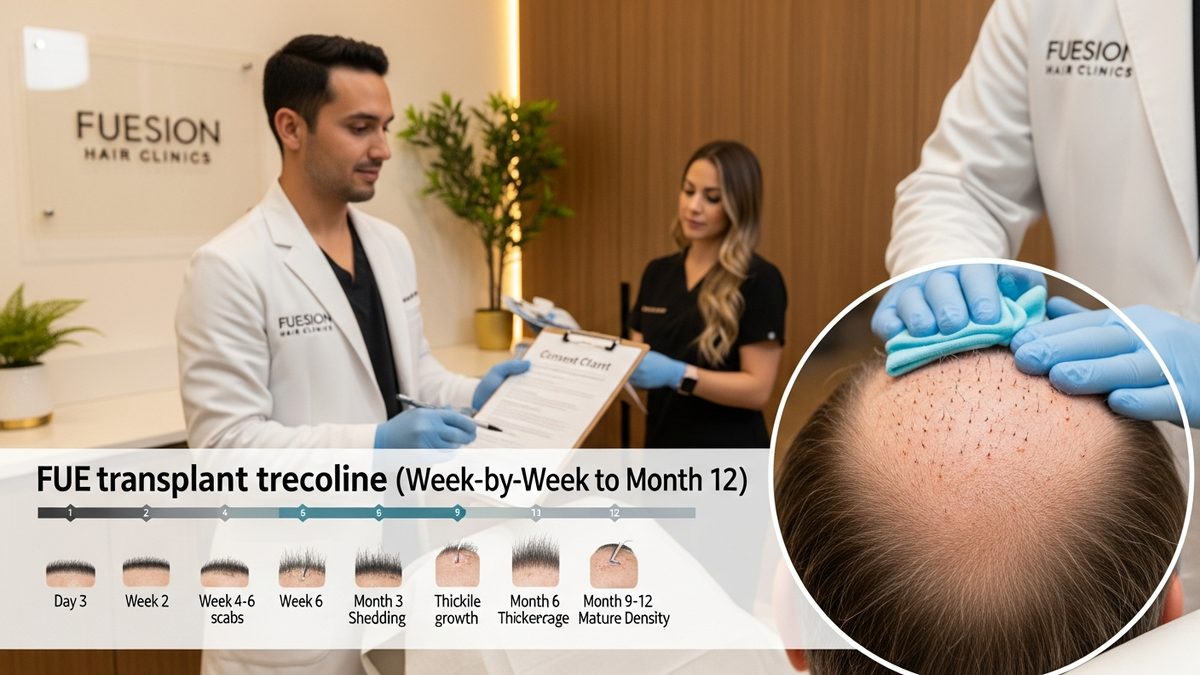
Planning your procedure is one thing—knowing what your body will do next is another. If you’re searching for a FUE hair transplant recovery timeline, you’re in the right place. After an FUE (Follicular Unit Extraction) procedure, the healing process follows a fairly predictable pattern: initial soreness and scabbing, early shedding, gradual regrowth, and long-term maturation of new hair. While every patient heals at their own pace, understanding the typical milestones can reduce anxiety and help you care for your scalp with confidence.
In this guide, we’ll walk you through a detailed week-by-week and month-by-month recovery plan—from day 1 through month 12—including common side effects and exactly when to contact FUEsion Hair Clinics. You’ll also find practical do’s and don’ts, and how your post-op regimen may support the best possible outcome.
Quick overview: the phases of FUE hair transplant recovery
Although your timeline will be individualized, most FUE patients move through these general phases:
- Immediate healing (days 1–7): redness, tightness, and scab formation.
- Scab shedding & early stabilization (week 2–3): crusts loosen and fall; the scalp settles.
- Shock shedding (around week 4–10): transplanted hairs shed; follicles shift into regrowth mode.
- Early regrowth (months 3–4): fine “baby hairs” appear.
- Thickening and maturation (months 5–12): density increases and hairs become more terminal.
If you’re considering additional support alongside surgery, many patients ask about medical and supportive options. Depending on your clinical assessment, FUEsion Hair Clinics may discuss evidence-based adjuncts such as topical or oral medications (e.g., finasteride/dutasteride when appropriate), minoxidil, and in-clinic or at-home photobiomodulation and scalp-care protocols to complement surgical results.
FUE hair transplant recovery timeline: day 1 through week 12
Day 1 (post-op day): what you’ll likely feel
What’s normal: mild to moderate discomfort, tightness, and redness in the donor and recipient areas. You may see small dots or raised areas where grafts were placed.
What to do:
- Follow your clinic’s instructions for sleeping position (often head elevated).
- Take prescribed medications as directed.
- Keep the dressing/wrap (if used) exactly as instructed.
Common side effects: swelling, tenderness, and a “sunburn” feeling.
Contact your clinic if: you experience severe pain that is not controlled by medication, rapidly worsening swelling, or heavy bleeding.
Days 2–3: swelling peaks for many patients
What’s normal: swelling can increase, sometimes moving toward the forehead or around the eyes. Redness typically persists.
What to do:
- Continue prescribed anti-inflammatory/antibiotic regimens if provided.
- Avoid strenuous activity and bending over for extended periods.
- Use cold compresses only if your surgeon approves and only in the recommended manner.
Common side effects: itchiness beginning under the surface, mild oozing/crusting.
Contact your clinic if: you develop fever, pus-like discharge, or swelling that is significantly worsening after day 3–4.
Days 4–7: scabs form and settle
What’s normal: scabs/crusts begin to form around graft sites. The scalp may feel dry or tight.
What to do:
- Start gentle washing only if your post-op plan says it’s time (many clinics begin a staged wash routine).
- Do not pick scabs—let them loosen naturally.
- Wear clean, breathable headwear if recommended; avoid friction.
Common side effects: dryness, mild flaking, and itch.
Contact your clinic if: you notice increasing warmth, worsening redness, or foul odor from the surgical sites.
Week 2: scab shedding begins (and patience matters)
Days 8–10
What’s normal: scabs loosen and begin to shed. You may see tiny fragments when washing.
What to do:
- Follow your clinic’s washing schedule and technique.
- Use the recommended shampoo and avoid harsh scrubbing.
- Keep hair and scalp clean to reduce the risk of folliculitis.
Days 11–14
What’s normal: most crusting resolves. The recipient area typically looks less inflamed, though there may be residual redness.
Common side effects: temporary numbness or altered sensation; continued mild redness.
Contact your clinic if: you develop persistent pus bumps or spreading redness.
Week 3: scalp stabilizes, grafts “rest”
Days 15–21
What’s normal: the scalp often feels smoother. You may still notice small scabs that take longer to dissolve.
What to do:
- Continue gentle hair washing and avoid scratching.
- Resume light daily activities if cleared by your surgeon.
- Avoid direct sun and protect from wind/dust exposure.
Common side effects: mild itch; dryness.
Weeks 4–6: shock shedding begins (often the most emotional phase)
Week 4
What’s normal: transplanted hairs commonly shed. This is called shock loss and does not mean graft failure.
What to do:
- Keep washing as directed—do not “overwash,” but don’t skip either.
- Expect that the hairline or density may look temporarily worse.
Week 5
What’s normal: shedding continues for many patients. The recipient sites may appear bare or patchy.
Common side effects: scalp sensitivity; occasional follicle-level redness.
Week 6
What’s normal: shedding usually begins to taper. Some patients start noticing slight regrowth or “stubble.”
Contact your clinic if: you have severe pain, thick crusting that returns, or signs of infection.
Weeks 7–12: early regrowth and gradual improvement
Week 7–8
What’s normal: fine hairs may start emerging. They can be lighter in color and texture than your eventual mature hair.
What to do:
- Maintain your routine: gentle cleansing, scalp protection, and medication compliance if prescribed.
- Take progress photos (same lighting/angle) to track changes objectively.
Week 9–10
What’s normal: many patients see improved coverage, though density is still developing.
Week 11–12
What’s normal: early thickness may become more apparent. Some patients notice the “baby hair” phase is shifting toward more visible strands.
Important expectation: results are still evolving—true maturation continues well beyond month 12.
FUE hair transplant recovery timeline: months 4 through 12
Month 4 (weeks 13–16): baby hair becomes more noticeable
What’s normal: new growth is typically visible. Texture may improve, and hairs may start to look more uniform.
What to do: keep follow-up appointments and follow any clinician-guided regimen for scalp health.
Month 5 (weeks 17–20): density begins to build
What’s normal: more follicles produce hairs, and shedding should be largely resolved. Coverage improves, especially in the treated areas.
Month 6 (weeks 21–24): stronger shafts and better coverage
What’s normal: hairs often become thicker. The difference between early regrowth and mature growth becomes more obvious.
Common side effects (less common now): mild scalp dryness or sensitivity if you’ve continued certain topical products.
Month 7 (weeks 25–28): continued thickening
What’s normal: density increases and styling becomes easier. Some patients begin to feel satisfied with how the hairline frames the face.
Month 8 (weeks 29–32): visible maturation
What’s normal: the hair begins to look more “complete.” Color and curl pattern may align more closely with your native hair.
Month 9 (weeks 33–36): natural blending improves
What’s normal: blending continues as the hairs lengthen and thicken. If you had a crown or mid-scalp restoration, this is often when patients notice meaningful improvement.
Month 10 (weeks 37–40): ongoing refinement
What’s normal: density and texture keep improving. Any remaining “finer” hairs may gradually catch up.
Month 11 (weeks 41–44): maturation accelerates for some patients
What’s normal: many patients see a more confident look, though individual variation is expected.
Month 12 (weeks 45–52): your one-year checkpoint
What’s normal: month 12 is a key milestone. Many patients see substantial cosmetic improvement by this stage, but final maturation can continue beyond a year.
What to do: attend your follow-up appointment to review progress, discuss long-term maintenance, and optimize ongoing hair health strategies.
Common side effects after FUE (and when to call)
Most side effects are temporary. Still, knowing what’s normal—and what’s not—helps you recover safely.
1) Swelling
- Typical course: peaks around days 2–4, then improves.
- When to contact FUEsion: swelling that worsens after day 4–5, severe pain, or swelling with fever.
2) Redness and scabbing
- Typical course: redness is common for the first 1–2 weeks; scabs loosen around week 2.
- When to contact FUEsion: rapidly spreading redness, increasing tenderness, or signs of infection.
3) Itching and tightness
- Typical course: mild itching is common, especially as scabs form and fall.
- When to contact FUEsion: intense itching with bumps, oozing, or burning pain.
4) Shock shedding
- Typical course: often begins around week 4 and may last through week 8–10.
- When to contact FUEsion: if you have severe inflammation or infection signs—not just shedding.
5) Numbness or altered sensation
- Typical course: can occur in donor and recipient areas; often improves over weeks to months.
- When to contact FUEsion: if numbness is severe, persistent, or accompanied by worsening pain.
Post-op care essentials (what helps your recovery)
Your surgical result is built in the operating room—but your recovery quality and long-term outcome depend heavily on what happens afterward. Below are general principles; always follow the specific instructions provided by your surgeon.
Hair washing and scalp hygiene
- Use only the shampoo and technique your clinic recommends.
- Avoid picking scabs or rubbing aggressively.
- Keep the scalp clean to reduce folliculitis risk.
Activity, sleep, and sun protection
- Avoid heavy exercise early on (often at least the first 1–2 weeks, or as instructed).
- Sleep with your head elevated for the early healing period.
- Protect from direct sun and extreme wind/dust exposure—especially during scab shedding.
Medication adherence
If you were prescribed medications (pain control, antibiotics if applicable, anti-inflammatory meds), take them exactly as directed. If you’re considering hair-loss medications for long-term maintenance, confirm timing with your surgeon—some regimens are started early, others later, depending on your healing and clinical profile.
How FUEsion Hair Clinics supports long-term hair health after surgery
A strong FUE result isn’t only about graft survival—it’s also about optimizing the environment where your follicles will regrow. Many patients benefit from a structured, medically guided plan that can include:
- Evidence-based maintenance therapy (when appropriate): medications such as finasteride/dutasteride and/or minoxidil, tailored to your medical history.
- Targeted scalp care: gentle cleansers and anti-inflammatory support to reduce scalp irritation.
- Photobiomodulation: red/near-infrared light protocols for supportive follicle signaling (clinic- or device-guided).
- Nutrition and supplementation: a clinically appropriate approach to support hair health.
At FUEsion Hair Clinics, we emphasize follow-up and personalization—because the best recovery plan is the one that matches your healing pace, donor/recipient characteristics, and long-term goals. If you’re also exploring genetic insights for hair health, ask about our HairIQ-style approach to support a more individualized maintenance strategy.
For example, some patients choose adjunctive regimens that may include nutraceutical support and scalp treatments designed to address inflammation and follicle health. If you’re interested in these options, bring your questions to your consultation so your plan can be aligned with your surgical timeline.
Anchor: FUE hair transplant recovery timeline—what to expect at each major milestone
- Day 1–3: discomfort, swelling, and early redness
- Week 2: scab shedding begins
- Weeks 4–10: shock shedding (normal)
- Months 4–6: visible regrowth and thickening
- Month 12: major checkpoint for density and maturation
Week-by-week “at a glance” checklist
| Timeframe | Most common experience | Do this | Call the clinic if |
|---|---|---|---|
| Day 1 | Redness, tightness | Follow meds + head elevation | Severe uncontrolled pain or heavy bleeding |
| Days 2–3 | Swelling increases | Avoid strenuous activity | Fever or rapidly worsening swelling |
| Days 4–7 | Scabs form | Gentle washing if cleared | Foul odor or worsening warmth |
| Week 2 | Scabs loosen | Don’t pick; follow wash routine | Spreading redness or pus bumps |
| Weeks 4–10 | Shock shedding | Be patient; track photos | Severe inflammation or infection signs |
| Months 4–6 | Baby hair + thickening | Keep maintenance plan consistent | Persistent painful bumps |
| Month 12 | Major maturation checkpoint | Review results and long-term strategy | Any concerning new symptoms |
When to contact FUEsion Hair Clinics during recovery
It’s normal to have questions during your healing journey. In general, you should contact your clinic if you notice:
- Fever (especially within the first week)
- Increasing redness after it initially begins to improve
- Pus-like discharge or foul odor
- Severe pain that doesn’t respond to prescribed medication
- Rapidly worsening swelling
- Uncontrolled bleeding
If you’re unsure whether something is normal, it’s always safer to ask. FUEsion Hair Clinics can help you interpret symptoms in the context of your specific procedure and postoperative instructions.
FAQ: FUE hair transplant recovery timeline
1) Is shock shedding normal in the FUE hair transplant recovery timeline?
Yes. Shock shedding commonly occurs around weeks 4–10. Transplanted hairs may fall out while the follicles remain alive and begin the regrowth phase. This is one of the most common—yet temporary—parts of recovery.
2) When will I see real hair growth after an FUE procedure?
Many patients notice fine “baby hairs” around months 3–4, with more visible thickening and density from months 5–8. By month 12, results are often substantially improved, though maturation can continue beyond a year.
3) What should my scalp look like in week 2 and week 3?
In week 2, scabs typically loosen and shed. By week 3, the scalp usually stabilizes with less crusting and less visible inflammation. Gentle cleansing and avoiding scab picking are key.
4) How long does swelling last after FUE?
Swelling often peaks around days 2–4 and then gradually improves. If swelling worsens after day 4–5, or is accompanied by fever or severe pain, contact your clinic promptly.
5) Can I speed up my recovery or regrowth?
You can’t safely “force” growth, but you can support optimal healing by following your surgeon’s post-op instructions, attending follow-ups, using recommended medications/topicals if prescribed, and protecting your scalp from sun and trauma. Many patients also ask about evidence-based maintenance strategies discussed during consultation.
Additional recovery support options (ask during your consultation)
Because your FUE hair transplant recovery timeline is influenced by both surgical factors and ongoing hair-health maintenance, your surgeon may discuss adjunctive options. Depending on your case, these can include:
- Medical therapy for ongoing hair loss stabilization (e.g., finasteride/dutasteride when appropriate, and/or minoxidil).
- Anti-inflammatory scalp care to help reduce irritation and support a healthy regrowth environment.
- Photobiomodulation protocols (in-clinic or at-home), which may support cellular signaling and scalp health.
- Nutrition and supplementation aligned with your needs and tolerances.
These recommendations should be individualized—what’s helpful for one patient may not be appropriate for another.
Your next step: plan your consultation with FUEsion Hair Clinics
If you’re scheduled for FUE surgery—or still deciding—your best advantage is clarity. A personalized consultation helps you understand your expected recovery pace, the likelihood of shock shedding, how your hairline or crown area may evolve, and what long-term maintenance strategy fits your medical history.
Schedule a consultation
Ready to map your recovery timeline? Contact FUEsion Hair Clinics to discuss your goals, review your hair-loss pattern, and build a post-op plan designed for your success.
- Review your candidacy for FUE and graft strategy
- Discuss expected milestones (including shedding and month-by-month regrowth)
- Plan your maintenance options for the months after surgery
CTA: Schedule a consultation with FUEsion Hair Clinics today.
Medical Information Disclaimer
This content is provided for general educational purposes only and reflects the clinical experience and protocols followed at FUEsion Hair Clinics. It is not a substitute for professional medical advice, diagnosis, or treatment. Patients are advised to consult a qualified hair restoration specialist for personalized recommendations.