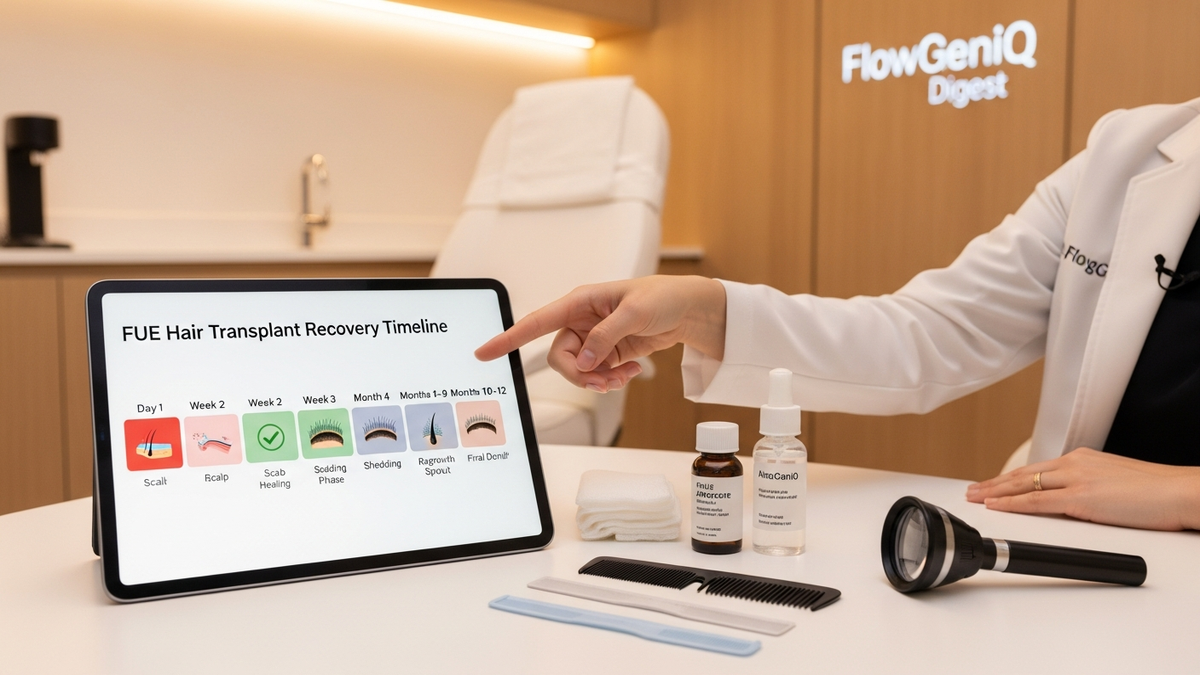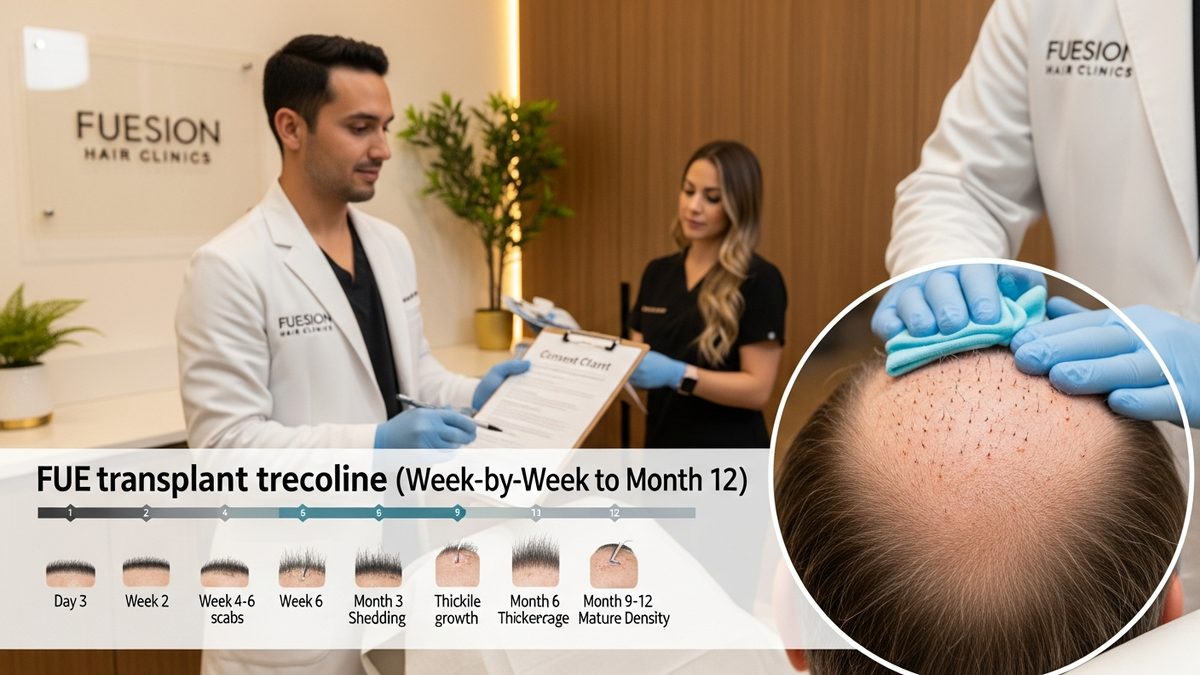
Planning an FUE hair transplant is exciting—and understandably a little nerve-wracking. The best way to feel confident is to know what usually happens next. In this guide, we walk you through a detailed FUE hair transplant recovery timeline from day 1 through month 12, including the most common side effects, practical aftercare tips, and exactly when to contact FUEsion Hair Clinics.
Every patient heals differently, and your surgeon’s protocol takes priority. This timeline is designed to help you recognize typical milestones so you can stay on track with safe, effective recovery.
Quick navigation: Week 1 | Weeks 2–4 | Months 2–3 | Months 4–6 | Months 7–12 | Common side effects | FAQ
Overview: What “recovery” means after an FUE hair transplant
After FUE (Follicular Unit Extraction), each graft is placed into tiny recipient sites. Recovery is a process, not an event. You’ll experience changes in appearance (redness, scabbing, shedding), then gradual regrowth as transplanted follicles re-enter the hair cycle.
Most patients progress through four phases:
- Inflammation & wound healing (days to ~2 weeks)
- Scab shedding & early sensitivity (around days 7–14)
- Shock loss / shedding (often weeks 2–10)
- New growth & maturation (months 3–12+)
At FUEsion Hair Clinics, we pair your surgical plan with evidence-informed aftercare guidance so you know what to do—and what to avoid—during each phase.
The FUE hair transplant recovery timeline (day 1 to month 12)
Below is a week-by-week guide that reflects typical healing patterns after FUE. Your exact timeline may shift depending on graft number, your skin type, and whether you’re combining FUE with adjunct treatments such as PRP or low-level laser therapy (LLLT).
Day 1 (post-op): Protect the grafts and reduce irritation
- What you may see: redness at the recipient area, tightness, mild swelling (often forehead/temples), and tiny dot-like extraction sites.
- What you may feel: tenderness, heat, or itching as the scalp reacts to healing.
- What to do: follow your clinic’s dressing/wash instructions precisely. Keep the head elevated and avoid pressure on the transplant area.
- What to avoid: touching, scratching, heavy sweating, and bending over for long periods.
Days 2–3: Swelling peaks for many patients
- What you may see: swelling may increase, especially around the hairline.
- Common sensations: scalp sensitivity, mild burning, and intermittent itching.
- Aftercare focus: gentle rinsing or washing as instructed, careful medication adherence (antibiotic/anti-inflammatory if prescribed), and strict avoidance of friction.
Days 4–5: Early scab formation
- What you may see: small scabs/“crusts” develop around grafts.
- What to do: continue your prescribed cleansing routine. Scabs should loosen naturally—do not pick.
- What to avoid: direct sunlight, swimming, and any activity that causes perspiration to pool on the scalp.
Days 6–7: Itching increases as healing progresses
- What you may feel: itching is common as the wound surface dries.
- What to do: follow your clinic’s guidance for soothing measures (often gentle sprays/conditioners or prescribed topical care).
- When to contact us: if pain escalates significantly rather than improving, or if you notice spreading warmth/redness beyond mild post-op inflammation.
Week 1: Days 8–14 (scab shedding and visible “dots”)
Days 8–10
- Typical changes: scabs begin to loosen; you may see small flakes.
- Hair appearance: the transplant area can look patchy or darker due to scabbing and redness.
- Aftercare focus: gentle washing, pat-drying as instructed, and avoiding aggressive towel rubbing.
Days 11–14
- Typical changes: many scabs fall off naturally. Extraction-site redness may still be present.
- Common side effect: mild dryness or tightness.
- What to do: keep the scalp clean and moisturized according to your plan. Resume only approved activity levels.
Milestone: By the end of week 1, most patients can begin to feel more comfortable and see clearer skin texture—though the transplant area will not look “finished” yet.
Weeks 2–4: Shedding, sensitivity, and the “ugly duckling” phase
Week 2 (Days 15–21)
- What you may see: redness often fades, but the scalp can remain slightly pink.
- Common sensation: intermittent itching or tightness.
- Start of shedding: transplanted hairs may loosen as follicles transition into the next hair cycle.
Week 3 (Days 22–28)
- Shedding becomes more noticeable: hairs may shed from transplanted follicles (often called shock loss).
- What’s normal: shedding does not mean graft failure. It’s a common part of regrowth.
- What to avoid: stopping prescribed meds early or switching hair products without approval.
Week 4 (Days 29–35)
- Scalp status: many patients feel mostly “back to normal,” but hair density will not yet reflect the transplant.
- What you may notice: the transplant area may look flatter or thinner temporarily.
- Aftercare focus: continue gentle cleansing and any treatment plan recommended by your clinic.
Months 2–3: Shock loss settles; early regrowth begins
Month 2 (Weeks 5–8)
- Shedding: often continues, then gradually slows.
- Scalp: usually calm with minimal redness.
- Hair changes: you may start to see fine, new hairs emerging, though they may be subtle.
Month 3 (Weeks 9–12)
- Regrowth: early growth may become more visible—especially in areas with better baseline follicle health.
- Texture: new hairs can be thinner and more delicate initially.
- Adjunct treatments (optional, patient-specific): some patients benefit from structured plans such as PRP, LLLT, or medically supervised topical regimens.
Months 4–6: Noticeable improvement for many patients
Month 4
- What improves: thickness begins to increase; hair may look fuller than at months 1–3.
- Growth rate: you may finally see meaningful cosmetic change.
Month 5
- Density: many patients experience continued gains in density.
- Hairline maturation: transplanted hairs may start blending more naturally with surrounding hair.
Month 6
- Milestone: this is often a “turning point” where regrowth becomes clearly visible.
- What to expect: hairs continue to thicken and lengthen; styling becomes more forgiving.
Months 7–12: Refinement, thickening, and long-term results
Month 7
- Progress: continued thickening and improved coverage.
- Consistency matters: staying aligned with your hair care routine and any medically supervised therapies.
Month 8
- Texture: stronger hair shaft characteristics may develop.
- Natural blending: hairline and mid-scalp coverage typically look more cohesive.
Month 9
- Density improvements: many patients see incremental gains.
- Photos help: compare standardized photos (same lighting/angle) for accurate assessment.
Month 10
- Ongoing maturation: hairs continue to transition from early growth to more stable thickness.
Month 11
- Coverage: often approaches the patient’s “final” look, though refinement continues.
Month 12
- Typical outcome: significant regrowth is usually present by month 12, with continued improvement possible beyond this point.
- Long-term plan: many patients benefit from maintenance strategies to support native hair and protect results (e.g., medically guided therapies and scalp health routines).
Important: If your progress feels slower than expected, it doesn’t automatically mean failure—timing varies. The best next step is a structured follow-up assessment with your surgical team.
Common side effects after FUE (and when to contact your clinic)
Most post-op effects are mild and self-limiting. Still, knowing what’s normal can prevent delays in care if something unusual occurs.
Normal and expected
- Redness at extraction and recipient sites (often fades over 1–3 weeks)
- Swelling (commonly mild to moderate; usually improves within several days)
- Itching (commonly peaks around days 6–10)
- Scabbing/crusting around grafts (typically loosens in week 1–2)
- Shock loss/shedding (often weeks 2–10)
- Temporary numbness or tightness (may gradually resolve)
When to contact FUEsion Hair Clinics urgently
Please reach out promptly if you experience any of the following:
- Increasing pain rather than gradual improvement
- Spreading redness, significant warmth, or worsening swelling after the early post-op period
- Fever or chills
- Pus or foul-smelling discharge from any area
- Severe or persistent bleeding not responsive to standard measures
- Rash or signs of allergic reaction to prescribed medications
- Unusually heavy crusting with significant tenderness (could suggest infection or excessive inflammation)
If you’re unsure, it’s always safer to contact your clinic. Early evaluation can make a meaningful difference.
Aftercare essentials that protect your grafts
Your surgeon will provide individualized instructions, but these are common pillars of a safe recovery.
Washing and scalp care
- Follow your clinic’s timeline for first wash and the exact cleansing method.
- Use only approved shampoo and products.
- Be gentle: pat, don’t rub. Avoid high-pressure water streams.
Activity, sleep, and friction control
- For the first 1–2 weeks, avoid heavy lifting, intense workouts, and activities that cause sweating.
- Sleep with your head elevated as directed.
- Avoid hats, tight headwear, and anything that rubs the transplant area.
Medications and treatment adherence
- Take prescribed medications exactly as directed.
- Do not start or stop hair-loss medications without guidance.
- If you’re using adjunct therapies (e.g., PRP, LLLT, topical treatments), confirm timing with your clinic.
Supporting regrowth: treatments patients often discuss
While the transplanted follicles do the “heavy lifting,” many patients optimize outcomes with medically supervised support—especially if there’s ongoing androgenetic hair loss risk.
Maintenance therapies (patient-specific)
- Finasteride or dutasteride (oral medications, when appropriate)
- Topical minoxidil (when appropriate)
- Anti-inflammatory scalp care to support follicle environment
Adjunct procedures
- PRP (Platelet-Rich Plasma): often considered to support scalp health and healing
- Low-level laser therapy (LLLT): may support follicle microenvironment
At FUEsion Hair Clinics, we focus on a personalized plan based on your pattern of hair loss, donor quality, and recovery needs. If you’re interested in precision approaches—including genetic or biomarker-informed hair health strategies—ask about what’s appropriate for your case during your consultation.
FUE hair transplant recovery timeline summary (fast reference)
| Timeframe | What you’ll likely notice | Typical action |
|---|---|---|
| Day 1–3 | Redness, tightness, swelling | Protect grafts; follow meds and head-elevated rest |
| Day 4–7 | Scab/crust formation; itching | Gentle cleansing; don’t pick scabs |
| Week 1 (Days 8–14) | Scabs loosen; redness fades | Continue approved wash routine; avoid friction |
| Weeks 2–4 | Shock loss/shedding; patchy appearance | Stay consistent with aftercare; reassurance—shedding is common |
| Months 2–3 | Shedding slows; early growth | Track progress photos; consider adjuncts if recommended |
| Months 4–6 | More visible density and thickness | Maintain routine; attend follow-ups |
| Months 7–12 | Thickening and maturation; improved coverage | Long-term maintenance plan for native hair |
FAQ: FUE hair transplant recovery timeline
1) Is the FUE hair transplant recovery timeline the same for everyone?
No. While most patients follow a similar pattern (healing → scab shedding → shock loss → regrowth), your pace can vary based on graft count, scalp sensitivity, skin type, and whether you’re using adjunct therapies. Your surgeon’s instructions are the most accurate guide for your specific recovery.
2) When will I see results after an FUE hair transplant?
Early changes may appear around months 3–4, with more noticeable density and thickness often around months 4–6. Many patients reach a major milestone by month 12, with continued maturation possible beyond that.
3) Why is my transplanted hair shedding—does that mean the grafts failed?
Shedding is commonly due to shock loss, a typical part of the hair cycle after transplant. It usually occurs within weeks 2–10. Graft failure is not diagnosed based on shedding alone—follow-up assessment is the right approach.
4) What side effects are normal during the first two weeks?
Normal effects include redness, swelling, itching, and scab formation. These typically improve week by week. Contact your clinic if you have escalating pain, fever, spreading redness, pus, or significant worsening swelling.
5) When should I contact FUEsion Hair Clinics during recovery?
Contact us if anything feels out of proportion (worsening pain, fever, foul discharge, spreading redness) or if you’re unsure whether a symptom is normal. Early evaluation helps ensure safe healing.
Schedule a consultation
If you’re considering or already scheduled for an FUE hair transplant, the best next step is a personalized plan tailored to your goals, donor supply, and recovery needs. At FUEsion Hair Clinics, we guide you through both the procedure and the FUE hair transplant recovery timeline—so you know what to expect at every stage.
Ready to move forward? Schedule a consultation to discuss your timeline, aftercare plan, and whether adjunct treatments (such as PRP or LLLT) may be appropriate for you.
Contact option: Schedule your appointment with FUEsion Hair Clinics to review your case and recovery expectations.
Medical Information Disclaimer
This content is provided for general educational purposes only and reflects the clinical experience and protocols followed at FUEsion Hair Clinics. It is not a substitute for professional medical advice, diagnosis, or treatment. Patients are advised to consult a qualified hair restoration specialist for personalized recommendations.